Understand the matrix.
Characterize the soil, identify molecules and understand the site's history.
SOLUTIONS / AGROCARBON®
A technology within Terrapure's remediation plan. Micron-sized activated carbon in an aqueous suspension to adsorb pesticide residues in the soil–water system.

BR 10 2023 018580-0
The starting point is still a thorough assessment. AgroCarbon is considered after the fields, residues present and agronomic objectives have been assessed. The application rate and method are determined through treatability testing and a pilot trial. Monitoring combines soil response, crop quality and treatment costs.
Explore the complete program ↗AGROCARBON® / FIELD APPLICATION
A liquid suspension of activated carbon, developed to simplify soil application through irrigation water.
AgroCarbon can be diluted and dispersed in irrigation water, integrating treatment into routine farm operations. Combined application with nutrients can be assessed for compatible mixtures, with dilution and system requirements defined by the technical team.
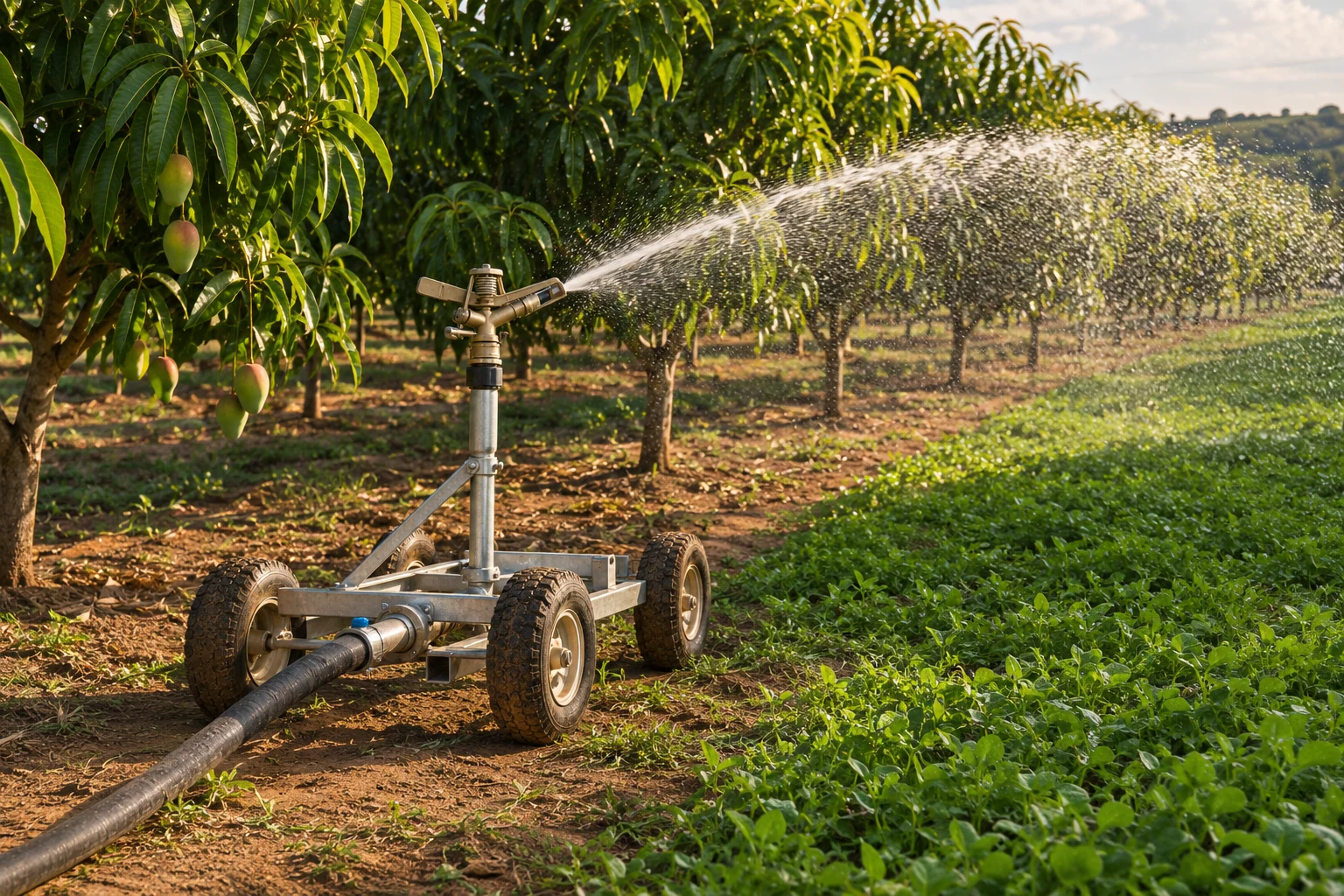
Mobile irrigators and sprinkler systems distribute water over the field. The addition of AgroCarbon is planned around equipment flow rates, nozzles and distribution uniformity.
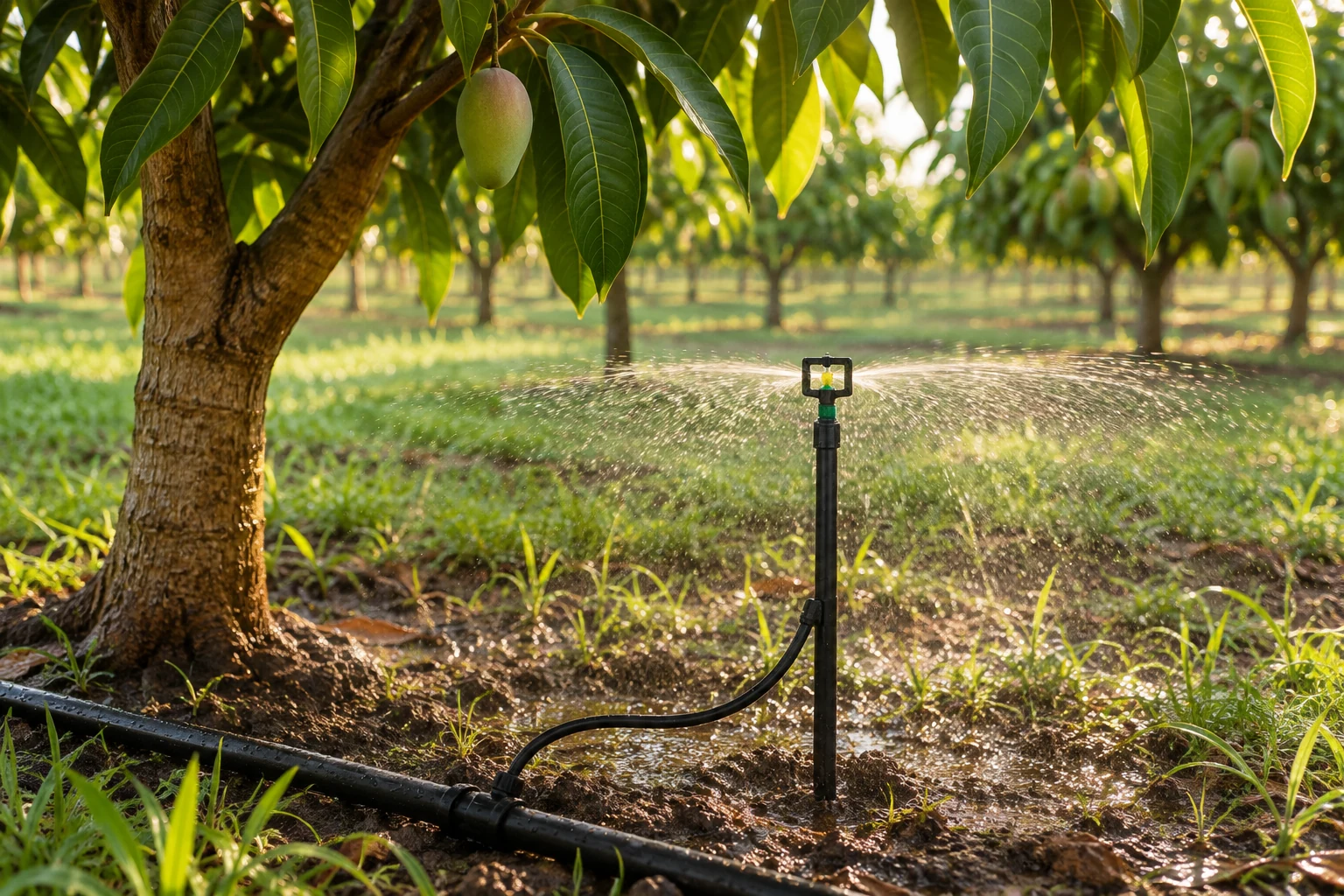
Microsprinklers wet an area around each plant. Application of the suspension accounts for the wetted area, filtration and particle passage through the selected emitters.
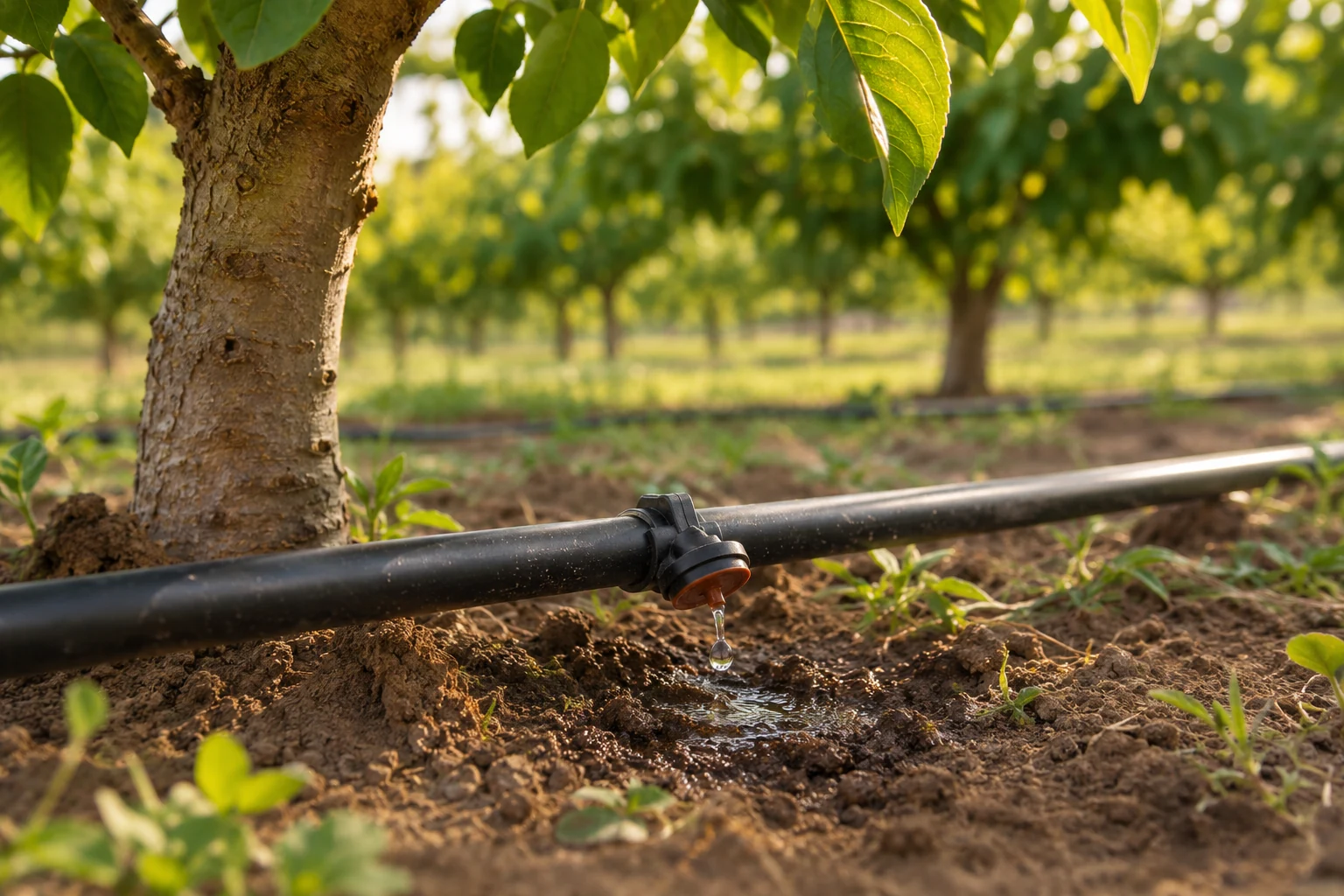
Drip lines deliver water near the roots. AgroCarbon use in this system requires validation with the filters and internal flow paths of the drip emitters.
AI-generated illustrative images. They show irrigation methods, not documented AgroCarbon trials.
Conventional sprinklers, traveling hose-reel irrigators and center pivots may also be included in the technical application assessment.
THE DIFFERENCE LIES IN THE FORMULATION
AgroCarbon's dispersion technology was developed to keep activated carbon particles in suspension, support their distribution through water and reduce the tendency for settling and deposits to form in pipes.
This is the formulation's objective: to make application easier and reduce the risk of blockages while the system operates under the conditions defined for the project.
Assess my irrigation systemPotential for combined application through fertigation, following an assessment of mixture stability and agronomic compatibility.
Carbon remains dispersed as particles: it does not dissolve in water. The absence of settling or clogging must be confirmed for the specific combination of product, water, nutrients, filters and emitters used.
FROM PREPARATION TO DISTRIBUTION
Characterize the farm's water, equipment, filters and emitters.
Assess dilution, stability and compatibility with the nutrients to be used.
Run a pilot trial and monitor flow rate, pressure, uniformity and soil response.
Explore irrigation systems and general compatibility criteria for fertigation. The sources below describe these practices; they do not constitute AgroCarbon compatibility tests.
Aegro · Types of agricultural irrigation ↗Embrapa · Fertigation and nutrient compatibility ↗01 / THE TECHNOLOGY
Caring for the next harvest starts with what remains in the soil.
Conceptual images based on the patented technology.
AgroCarbon® uses micron-sized activated carbon in an aqueous suspension to adsorb pesticide residues in the soil solution.
Molecules associate with the carbon's surface and pores, reducing the dissolved fraction available in the soil–water system. This physical retention mechanism guides the development of the technology.
Understand adsorptionINSIDE THE PROCESS
Without the adsorbent, some pesticides may remain dissolved in the water present in the soil.
02 / EXPERIMENTAL EVIDENCE
Research using soils from a banana farm in Cajati, São Paulo. Laboratory tests compared the aqueous phase from soils with and without AgroCarbon®.
of hexazinone in the aqueous phase, compared with soil without the product.
LABORATORY TEST · 8 HOURS| Pesticide | Without AgroCarbon® µg/L | With AgroCarbon® µg/L | Minimum reduction |
|---|---|---|---|
| Hexazinone | 23.21 | <0.88 | >96.2% |
| Imidacloprid | 20.34 | <1.07 | >94.7% |
| Diuron | 15.45 | <1.62 | >89.5% |
| Indaziflam | 6.09 | <0.77 | >87.3% |
HOW TO READ THE RESULTS
The percentages are minimum reductions calculated as 100 × (1 − detection limit / concentration without product), rounded down. Below the detection limit does not mean zero concentration.
SCOPE OF THE EVIDENCE
The tests assessed the aqueous phase. Reductions in root uptake, residues in food and field performance require specific validation.
The study by Isadora Kitahara Moreira, conducted at UTFPR (2026), used real agricultural soils and a pesticide mixture added in the laboratory. Batch tests used 2.0 g of soil, 10 mL of solution and a nominal initial concentration of 30 µg/L per pesticide. Following agitation, centrifugation and filtration, the supernatant was analyzed by LC-MS/MS.
With 0.60 g of AgroCarbon® per 2.0 g of soil, all four highlighted pesticides were below the detection limit in areas A2, A3 and A6 at the evaluated times between 0 and 72 h. In soil A2, results remained below the detection limit with 0.10, 0.20 and 0.30 g after 8 h. These laboratory ratios are not field application rate recommendations.
Source: Moreira, I. K. AgroCARBON® como adsorvente para pesticidas em solo contaminado: avaliação experimental da eficiência de adsorção. Master's thesis, UTFPR, 2026. Tables 4–7. The data are exploratory; the study reports limitations in replication and extrapolation to field conditions.
Download the evidence summary (PDF in Portuguese)GUIDED APPLICATION
The adsorption mechanism supports assessment in impacted soils and investigation of residue availability to subsequent crops. Root uptake, food residues and agronomic performance require specific validation.
Characterize the soil, identify molecules and understand the site's history.
Compare samples with and without the product using a protocol with controls and indicators.
Monitor residues, crop response, marketable yield and costs before scaling up application.
LET'S BUILD THIS ASSESSMENT.
Technology selection starts with understanding your field.
Discuss my farm