Field history
Products applied, rates, dates and the sensitivity of the next crop.
ABOUT TERRAPURE
Investigation, remediation and biological management to restore soil potential, pursue higher productivity and add value to harvested crops.
Explore the five areas
01 / AGROCARBON® AND PHYTOTOXICITY
Agrochemical residues can limit the establishment of sensitive crops. Terrapure investigates this constraint and evaluates AgroCarbon, micron-sized activated carbon, as a tool to adsorb certain compounds and reduce their availability in the soil–water system.
The aim is to mitigate phytotoxicity and support germination, emergence and early root development. For each soil, seed and molecule, we compare treated samples and controls in bioassays before recommending application at scale.
Explore the technology and trials02 / RECOVERY BETWEEN PLANTINGS
When persistent residues harm the next crop, the time needed for recovery also affects farm returns. Terrapure evaluates whether mitigating these residues with AgroCarbon can accelerate the soil's functional recovery and reduce constraints on replanting.
The decision combines chemical testing, bioassays using the next crop and field monitoring. The interval between crops can then be planned using indicators of the field's response.
A shorter interval between crops is a possibility that must be validated. Treatment does not override label-required safety intervals, crop rotation restrictions or fallow periods required by other agronomic conditions.
WHAT GUIDES THE DECISION
Products applied, rates, dates and the sensitivity of the next crop.
Residue availability and seed and root responses.
Agronomic conditions, planting window and recovery costs.
03 / CARBON, WATER AND NUTRIENTS
Amazonian Dark Earths, formed over time through the activities of Indigenous peoples, inspire research into carbon and fertility. Their richness results from interactions among charred materials, organic matter, minerals and biological activity.
Research on biochar indicates potential to increase water retention. The response depends on the material, application rate and soil characteristics.
Charred materials can help retain and cycle nutrients, together with organic matter and fertility management.
Improving water and nutrient conditions is a strategy for pursuing more consistent yields during periods of stress.
AgroCarbon contributes to this discussion through the use of a carbon-based material, with a specific focus on contaminant adsorption. Amazonian Dark Earth, biochar and activated carbon have distinct characteristics and functions.
Water and nutrient benefits studied in other materials cannot automatically be attributed to AgroCarbon. Its contribution in these areas must be measured at the application rate and in the soil used in the project.
Consult Embrapa research04 / SOIL BIOLOGY AND FIELD PRODUCTIVITY
Microbiological assessment adds another layer to the analysis of residues, nutrients and soil structure. DNA analyses help characterize the microbial community; biological activity indicators complement this information.
Using these findings, Terrapure develops management options to support soil biota suited to the crop: cover crops and rotation, organic matter inputs, correction of limiting factors and assessment of inoculants compatible with the production system.
The aim is to support functions such as nutrient cycling and root development, while monitoring their relationship with productivity and harvest quality.
Understand DNA-based assessmentAN INTEGRATED ASSESSMENT FOR EACH FIELD
Community composition and groups of interest.
Biological indicators, chemistry and physical conditions.
Interventions tailored to the crop and field history.
Marketable yield, quality and returns per hectare.
DNA alone does not demonstrate activity or increased productivity. Results are monitored in comparison areas and across crop cycles.

05 / QUALITY AND MARKET ACCESS
Investigating residue sources and evaluating remediation techniques may help reduce the availability of certain pesticides in the soil and, potentially, their uptake by plants. The aim is to support the production of food with lower residues and greater potential value.
For exports, we combine field assessment with application history, buyer requirements and food testing. Limits are specific to each combination of substance, commodity and market.
A reduction observed in soil water does not guarantee a reduction in fruit. Compliance is verified by testing the food and production lot with appropriate methods and quantification limits. Application practices and postharvest management are also part of this assessment.
REFERENCES FOR PLANNING
Examples of legal limits in food.
Sources consulted in November 2026.
Swipe the table to see limits and sources →
| Market | Substance and fruit | Limit | Legal basis |
|---|---|---|---|
| European Union | Thiamethoxam Mangoes and table grapes | 0.01 mg/kg* | Regulation (EU) 2023/334 ↗Amends Regulation (EC) No 396/2005 |
| European Union | Clothianidin Mangoes and table grapes | 0.01 mg/kg* | Regulation (EU) 2023/334 ↗Amends Regulation (EC) No 396/2005 |
| United States | Imidacloprid Mangoes and grapes | 1.0 mg/kg** | 40 CFR § 180.472(a) ↗EPA-established tolerances |
| United States | Imidacloprid Bananas | 0.5 mg/kg** | 40 CFR § 180.472(a) ↗EPA-established tolerances |
* Limit of analytical determination specified in the European regulation, applicable from March 7, 2026, subject to the transitional provision in Article 2.
** 1 ppm equals 1 mg/kg. The US residue definition includes the sum of imidacloprid and metabolites containing the 6-chloropyridinyl moiety, expressed as imidacloprid equivalents.
These values apply to food, not soil. They are examples, not a complete list. Confirm the current regulation, residue definition and buyer requirements for each shipment. Brazilian use authorizations must be checked separately with Anvisa, the product registration and the label.
Soil, water and management history.
Treatability, pilot testing and source control.
Food testing and lot traceability.
 Corporate photograph · GEOAMBIENTE
INVESTOR · SOLUTION DEVELOPMENT
A chemical engineer trained at UFPR, with postgraduate qualifications in Environmental Engineering, he has worked in contaminated-site management since 1998. He is the founder and CEO of GEOAMBIENTE and has ownership interests in companies including LABGEO.
At Terrapure, he brings this experience to the development of agricultural solutions. His research and innovation work includes several patent applications for environmental decontamination and the patented AgroCarbon invention.
Explore the AgroCarbon patent ↗ANALYTICAL SUPPORT
LABGEO®LABGEO Laboratório e Pesquisas provides support for environmental soil and water analyses, investigations and bench-scale remediation trials. Batch and column studies can support the assessment of sample treatability.
The analytical plan confirms the compounds, methods, quantification limits and scope appropriate to each sample matrix. DNA, fertility, plant tissue and food testing are coordinated with specialized laboratories, with methods and scope confirmed for each project.
Visit LABGEO ↗View licenses and accreditations · CRL 0644 ↗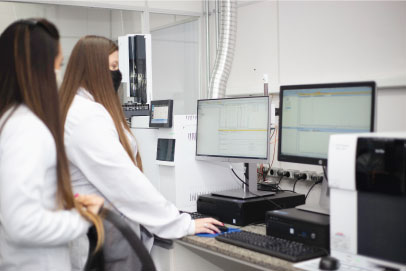 Corporate photograph · LABGEO
EXPERIENCE IN INVESTIGATION AND REMEDIATION
GEOAMBIENTE®GEOAMBIENTE works in environmental assessment, investigation, remediation and monitoring. This experience contributes to the evaluation of alternatives, intervention planning and site monitoring.
LABGEO and GEOAMBIENTE are companies in which Everton, a Terrapure investor, holds ownership interests. Each company's involvement and the scope of services are defined for each project.
Explore GEOAMBIENTE ↗LET'S BUILD THIS ASSESSMENT.
Tell us about your challenge and your goal for the next harvest. Let's connect soil quality to your farm's performance.
Discuss my farm